Leman Locke
Leman Locke Review: Is This East London Aparthotel Worth It?
What if your London hotel felt less like a hotel and more like your own stylish flat — complete with a fully equipped kitchen, sweeping city views, and a buzzing café-bar right downstairs? That’s the Leman Locke promise. But does it actually deliver?
Spoiler: mostly, yes. But there are a few things worth knowing before you book.
Leman Locke is an aparthotel on Leman Street in Aldgate, East London — a hybrid concept that sits somewhere between a self-catering apartment and a boutique hotel. It’s part of the wider Locke Hotels brand, which has built a reputation for design-led, community-focused properties across the UK and Europe. The pitch is simple: more space, more independence, and more personality than a standard hotel room, without sacrificing the convenience of a central London location.
This review covers everything. Rooms, design, food and drink at the Hyde café-bar, location and transport links, pricing, who it suits, and who it probably doesn’t. It’s based on a first-hand stay, with honest assessments of what works and what could be improved. If you’re weighing up whether Leman Locke is right for your trip, this guide should give you a clear answer.
Quick Verdict
| Category | Score / Detail |
|---|---|
| Overall Rating | 4.5 / 5 |
| Price Range | ~£120–£250 / night (season and room type dependent) |
| Best For | Solo travellers, couples, remote workers, long-stay guests, East London explorers |
| Location Score | 9.5 / 10 |
| Design Score | 9 / 10 |
| Value Score | 8 / 10 |
| Food & Drink Score | 8 / 10 |
| One-Sentence Verdict | A genuinely impressive design-led aparthotel in one of London’s most exciting neighbourhoods — particularly strong value for stays of three nights or more. |
What Is Leman Locke? Understanding the Aparthotel Concept
The aparthotel model isn’t new, but Leman Locke does it better than most. The basic idea: you get the space and self-sufficiency of a serviced apartment — your own kitchen, living area, and the freedom to come and go as you please — combined with the design quality and on-site amenities you’d expect from a good boutique hotel. It’s a genuinely useful middle ground that traditional hotels have never quite managed to occupy.
Aparthotel vs traditional hotel: what’s the difference?
In a standard hotel, you’re essentially renting a room. You sleep there, maybe eat breakfast there, and that’s about it. An aparthotel gives you more. At Leman Locke, that means a proper kitchen with a hob, fridge, microwave, pots, pans, and crockery — everything you need to cook a full meal if you want to. It means a living space that doesn’t double as your bedroom floor. And it means the kind of flexibility that hotel guests rarely get: no fixed meal times, no awkward check-in queues (usually), and no sense that you’re occupying a room that was identical to the one next door.
The catch — and it’s worth being upfront about this — is that some traditional hotel services don’t come standard. Daily housekeeping isn’t guaranteed (though it can often be arranged). Room service isn’t a thing here. There’s no concierge in the traditional sense. If those are non-negotiables for you, a conventional hotel might be the better fit.
The Locke Hotels brand and its design philosophy
Locke Hotels is a UK-founded brand with properties in London, Edinburgh, Dublin, Manchester, and a handful of European cities. The brand positions itself firmly at the design-conscious, culturally curious end of the market — not budget, but not stuffy five-star either. Think curated art on the walls, locally sourced café menus, and interiors that feel considered rather than corporate. Leman Locke fits that template well.
Who is Leman Locke best suited for?
Honestly, it’s best for people who want independence without sacrificing style. Solo travellers, couples, remote workers on extended stays, and anyone who’s tired of the generic hotel formula will find a lot to like here. Families needing multiple bedrooms, or guests who want the full white-glove hotel experience, will probably want to look elsewhere.
Leman Locke Location: Why Aldgate East Is a Great Base
Location is one of the strongest arguments for staying at Leman Locke. Aldgate sits right on the edge of the City of London and the creative sprawl of East London — which means you’re genuinely well-placed for almost everything, whether you’re here for business, culture, food, or nightlife.
Getting there: transport links and accessibility
The hotel is on Leman Street, a three-minute walk from Aldgate East tube station, which sits on the District and Hammersmith & City lines. That gives you direct access to South Kensington, Victoria, Paddington, and much of central London without a single change. London Liverpool Street station — served by National Rail and the Elizabeth line — is about a ten-minute walk away, connecting you to Heathrow in under 45 minutes and Stansted in around 45–50 minutes. For most travellers arriving in London, getting to Leman Locke is straightforward.
There’s no private parking on-site, so if you’re driving, you’ll need to factor in a nearby NCP or street parking, which — as with anywhere in central London — adds cost and hassle. The honest advice? Don’t drive. The tube connections are more than sufficient.
Accessibility provisions
The building is lift-accessible, meaning guests on upper floors do not need to use the stairs. The route from Aldgate East station to the hotel is largely step-free at street level, though prospective guests with specific mobility requirements should consult the TfL step-free tube map before travelling and contact the hotel directly to confirm room-level accessibility — including doorway widths, wet-room availability, and any other provisions relevant to their needs. Leman Locke’s front desk has generally been responsive to accessibility enquiries, but it’s always worth verifying in advance rather than assuming.
View Leman Locke on Google Maps
What’s within walking distance?
This is where Leman Locke genuinely earns its keep. Within a ten to fifteen-minute walk, you have:
- Brick Lane — famous for its curry houses, vintage markets, and street art
- Spitalfields Market — one of London’s best covered markets for food, fashion, and independent traders
- Shoreditch — bars, clubs, galleries, and some of the best street food in the city
- Whitechapel — the Royal London Hospital area, with its own food scene and cultural history
- The City of London — for anyone mixing business with leisure
Tesco Express and a handful of local shops are within easy reach for self-catering grocery runs — a small but genuinely practical detail for aparthotel guests.
Exploring the wider East London neighbourhood
Aldgate’s neighbourhood feel is hard to describe to someone who hasn’t spent time in East London. It’s creative, multicultural, and genuinely energetic — not in a manufactured, tourist-trap way, but in the way that comes from a neighbourhood shaped by waves of immigration, artistic communities, and rapid urban change. It’s the kind of place where a Bangladeshi curry house sits next to a natural wine bar without any sense of incongruity.
For travellers who want to experience London beyond the postcard version — beyond Buckingham Palace and the Houses of Parliament — this is exactly the right neighbourhood to base yourself in.
First Impressions: Checking In at Leman Locke
First impressions matter, and Leman Locke gets a lot of them right.
Leman Locke check-in time and process
Standard check-in is from 3pm, with check-out at 11am. That’s fairly typical for London hotels, though early check-in and late check-out can sometimes be arranged — either for a fee or depending on availability. If you’re arriving on a morning flight or an early train, it’s worth calling ahead rather than just turning up and hoping for the best. The front desk staff are generally accommodating when the schedule allows.
The check-in process itself is smooth. There’s no interminable queue or overly formal reception ritual. Staff are friendly without being performatively so — they give you what you need, answer questions directly, and let you get on with it. That tone fits the brand well.
The lobby and ground floor atmosphere
From the outside, Leman Locke is a modern high-rise building — glass, steel, and clean lines — that fits the Aldgate skyline without trying too hard to stand out architecturally. Step inside, though, and the atmosphere shifts immediately. The ground floor is stylish in a way that feels genuinely considered: warm lighting, carefully chosen furniture, and the kind of artwork on the walls that suggests someone actually thought about it rather than buying a job lot from a hotel supply catalogue.
It doesn’t feel like a hotel lobby. That’s intentional, and it works.
Hyde café-bar: first look
The Hyde café occupies the ground floor and is the social heart of the building. During the day, it functions as a specialty coffee spot — proper espresso-based drinks, artisan pastries, quiches, and sandwiches. The coffee is genuinely good, which matters if you’re the kind of person who thinks about these things.
By evening, Hyde transitions into a bar. The shift is subtle — the lighting dims slightly, the menu expands to include craft beers, wines, and cocktails — but it works. It’s the kind of place you’d happily sit in for an hour with a glass of wine before heading out for the evening, or return to for a nightcap after a long night in Shoreditch.
On arrival, there was a small welcome touch in the room — a complimentary gin and tonic, which felt like exactly the right gesture for this kind of property. Small detail, but it sets the tone.
The Rooms and Apartments at Leman Locke: A Detailed Look
The rooms are where Leman Locke either earns or loses you, depending on what you’re expecting. Let’s be specific.
Room types and configurations available
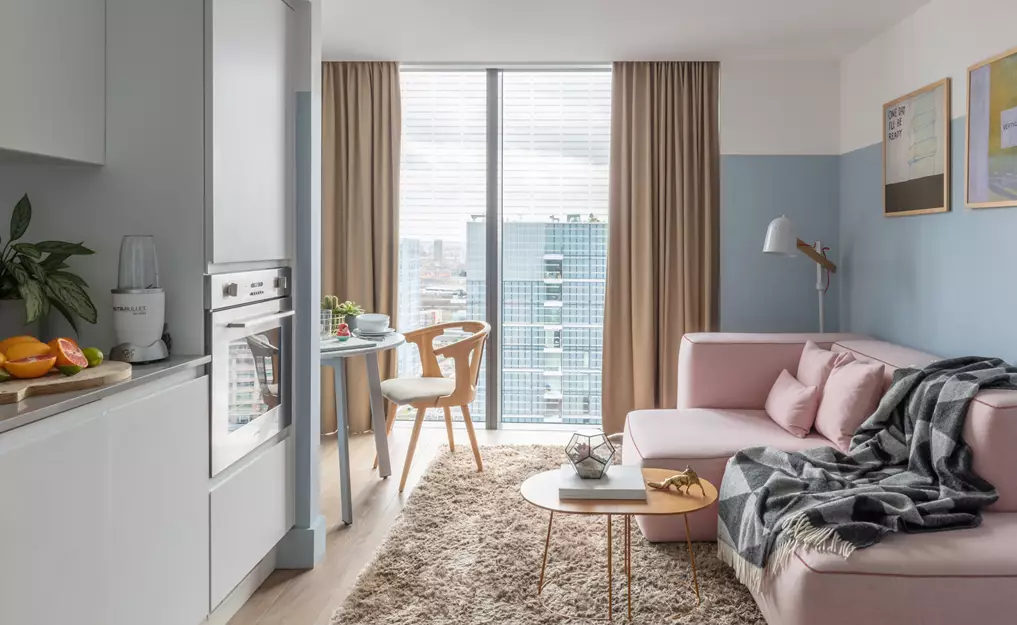
Leman Locke offers studios and one-bedroom apartments. Studios combine the sleeping area, living space, and kitchen into a single open-plan layout — compact, but cleverly designed so that nothing feels gratuitously crammed. One-bedroom apartments provide a separate bedroom, which makes a meaningful difference for couples or anyone staying more than a couple of nights who wants to maintain some sense of a living room that isn’t also their bedroom.
Room sizes vary by floor, with higher floors typically offering more space and — crucially — significantly better views.
Interior design and aesthetic
The design across all room types is genuinely impressive. There’s an art deco-inspired quality to the interiors: warm tones, textured finishes, and furniture that feels like it was chosen for the space rather than ordered in bulk. It doesn’t feel generic. That matters more than it might sound, because spending three or four nights in a room that has personality is a fundamentally different experience from spending those same nights in a beige box.
Artwork on the walls, thoughtful lighting choices, and quality soft furnishings all contribute to the sense that this is a space someone actually cared about designing.
Kitchen and self-catering facilities
The kitchen is fully equipped — and that phrase actually means something here, rather than being a euphemism for a kettle and a mini fridge. You get a two-ring hob, microwave, full-sized fridge, and a complete set of pots, pans, plates, glasses, and cutlery. Cooking a proper meal is entirely realistic. For longer stays, this is a significant practical advantage: being able to cook breakfast, or knock together a simple dinner after a long day, saves both money and the fatigue of eating out for every single meal.
Bathroom
The bathroom is one of the room’s standout features — notably spacious relative to the overall room size, which is not something you can say about most London hotels at this price point. Good water pressure, quality toiletries (refillable, which is a nice touch), and enough storage to actually unpack properly.
Views from the upper floors
If you can, book a room on one of the upper floors. The 22nd floor, in particular, offers a panoramic view of London’s skyline that’s genuinely jaw-dropping — the Shard, the Gherkin, the Walkie-Talkie, and stretches of the City and beyond, all laid out in front of you. It’s the kind of view that makes you realise how extraordinary London actually is when you see it from above. Worth the slight premium if the budget allows.
Tech, connectivity, and in-room amenities
WiFi is fast and reliable — important for remote workers and digital nomads, and an area where some aparthotels quietly underperform. There’s a smart TV, adequate storage (hanging space, drawers), and a desk or workspace area in most room types. It’s not a dedicated office setup, but it’s sufficient for a day of calls and emails. The overall tech provision is functional without being flashy, which is probably the right call.
Food and Drink at Leman Locke: The Hyde Café-Bar
Food and drink at Leman Locke is built around three pillars: the Hyde café by day, the Hyde bar by night, and the option to cook for yourself in your fully equipped apartment kitchen. That combination gives guests more flexibility than most hotels at this price point.
Breakfast and daytime café menu
Hyde opens early enough to catch the morning rush, serving specialty coffee alongside a rotating selection of artisan pastries, quiches, and sandwiches. The quality is genuinely above average — this isn’t a hotel coffee shop stocking pre-packaged muffins from a central distribution warehouse. The baristas know what they’re doing, the beans are sourced with some care, and the food options are fresh. It’s the kind of breakfast spot you’d choose to visit even if you weren’t staying in the building.
That said, it’s not a full cooked breakfast service. If a traditional English fry-up is your non-negotiable morning ritual, you’ll need to head to one of the nearby cafés on Commercial Street or Brick Lane.
Evening bar and drinks selection
By evening, Hyde’s atmosphere shifts noticeably. The coffee gives way to craft beers, a well-chosen wine list, and cocktails available on request. It’s a relaxed, genuinely pleasant bar — not a nightclub, not a hotel bar that feels like a waiting room, but something in between: the kind of place where you’d comfortably sit for two hours and not feel like you were overstaying your welcome.
As a pre-dinner or post-dinner stop, it works very well. After a night out in Shoreditch or Brick Lane, it’s a reliably good nightcap option.
Self-catering: cooking in your apartment
The fully equipped kitchen means that self-catering is a genuine, realistic option rather than a marketing claim. The nearest Tesco Express is a short walk away. Deliveroo and Uber Eats both operate in the area if cooking feels like too much effort on a particular evening. For longer stays especially, the ability to cook your own meals — even something as simple as breakfast and lunch — can meaningfully reduce the overall cost of the trip.
On pricing: Hyde’s food and drinks are priced at what you’d expect from a quality independent café-bar in East London — not cheap, but not unreasonable. A specialty coffee runs around £3.50–£4.50; a glass of wine in the evening is roughly £8–£12. Nothing to wince at if you’re already in the area.
How Much Does Leman Locke Cost? Pricing and Value for Money
Pricing is always contextual in London, so let’s be specific about where Leman Locke sits.
Nightly rates and seasonal pricing
Studio rooms typically start around £120–£150 per night during off-peak periods, rising to £180–£250 or more during peak seasons — summer, major events, and school holiday periods. One-bedroom apartments carry a modest premium over studios. These aren’t budget hotel prices, but they’re also nowhere near the rates charged by traditional four-star hotels in comparable central London locations.
Booking directly through the Locke Hotels website sometimes offers marginal savings over third-party platforms, along with more flexible cancellation terms — worth factoring in if your travel dates are uncertain. That said, Booking.com and similar platforms are worth checking for promotional rates, particularly for last-minute stays. It’s always worth comparing both.
How Leman Locke compares to nearby hotels
For context: a comparable room at a traditional four-star hotel in the City or Shoreditch — citizenM Shoreditch, for example, or a mid-range Marriott — typically runs £150–£220 per night, with none of the self-catering facilities that Leman Locke provides. A budget option like Qbic London (a ten-minute walk away) can be found for under £100 on some nights, but the room quality and overall experience are noticeably different.
Leman Locke sits in a sensible middle ground: it’s more expensive than the budget options, but the design quality, location, and self-catering facilities justify the difference for most travellers.
Is Leman Locke worth the price?
For shorter stays — a weekend break, say — the self-catering kitchen may not add much financial value, since most guests will be eating out anyway. The value proposition is stronger on stays of three nights or more, where the ability to cook even a few meals in the apartment noticeably reduces total spending. Add in the avoidance of a daily hotel breakfast charge (which in London can easily run £15–£25 per person), and the maths starts to look quite favourable.
Long-stay rates and extended stay options are available directly through Locke Hotels — weekly and monthly pricing is significantly more competitive than the standard nightly rate, making Leman Locke a genuinely viable option for remote workers or anyone in London for an extended period.
Overall verdict on value: strong, particularly for stays of three nights or more, and exceptional for digital nomads or remote workers on extended visits.
Pros and Cons of Staying at Leman Locke
Here is an honest breakdown of what works and what doesn’t.
What we loved
Location — Genuinely exceptional. Three minutes from Aldgate East tube, ten minutes from Liverpool Street, and walking distance from some of London’s most interesting neighbourhoods. Hard to fault.
Design and aesthetic — The interiors are stylish, personal, and genuinely well-considered. This doesn’t feel like a hotel that was decorated by committee.
Fully equipped kitchen — A real kitchen, with real equipment. Not a token gesture.
Spacious bathroom — Notably generous for a London hotel at this price point.
Views from upper floors — The 22nd floor views of the London skyline are, without exaggeration, spectacular.
Hyde café-bar — A genuinely good café by day and a relaxed, quality bar by night. The kind of on-site amenity that actually gets used.
Home-like atmosphere — The overall feeling of staying somewhere that has personality and independence, rather than anonymous hotel uniformity.
What could be improved
Compact open-plan layout in studios — For stays longer than three or four nights, the lack of separation between the sleeping and living areas can feel limiting. The one-bedroom apartments address this, but at a higher price.
Limited traditional hotel services — No room service, no concierge in the conventional sense, and housekeeping isn’t daily by default. If you want those things, this isn’t the right property.
Neighbourhood noise — Aldgate and the surrounding area can be noisy, particularly at weekends when Shoreditch is in full swing. Light sleepers should request a higher floor or a room facing away from the street.
No on-site parking — A minor issue for most guests, but worth flagging for anyone travelling by car.
Who should stay here — and who shouldn’t
Leman Locke is an excellent fit for: solo travellers, couples, remote workers, digital nomads, long-stay guests, and anyone who wants to experience East London’s creative, multicultural energy from a stylish, well-located base.
For families with children, it’s worth being direct: studios and one-bedroom apartments are not configured with families in mind. There are no interconnecting rooms, cots are not a standard advertised feature, and the open-plan layout makes early bedtimes tricky when adults want to remain in the living space. Families with young children would be better served by a serviced apartment provider with multi-room configurations, or a hotel offering dedicated family rooms. It’s not a dealbreaker for families with older teenagers who can share a space, but for younger children, the layout simply doesn’t work.
It’s probably not the right choice for: business travellers who need a formal corporate hotel environment with full concierge services, or guests who prioritise traditional hotel amenities above all else.
Leman Locke for Remote Workers and Long Stays
This is an aspect of Leman Locke that doesn’t get nearly enough attention in most reviews — and it’s arguably one of the property’s strongest selling points.
Working from Leman Locke: workspace and WiFi
The aparthotel model is, structurally, very well suited to remote work. You have a private, quiet space with a kitchen (meaning you’re not spending £15 on lunch every day), reliable high-speed WiFi, and a desk or workspace area in most room configurations. The WiFi performance during my stay was consistent and fast — sufficient for video calls, large file transfers, and the general demands of a working day without any notable drop-outs.
That said, the in-room workspace is functional rather than purpose-built. If you’re doing eight or more hours of focused work every day, a dedicated co-working space will serve you better ergonomically. Worth knowing.
Business travellers and ‘bleisure’ stays
Leman Locke is not well-suited to formal corporate stays. There are no meeting rooms, no corporate billing arrangements, and no concierge for restaurant bookings or client logistics. For that kind of trip, a traditional business hotel will serve you better.
That said, it can work very well for business travellers on less formal trips — particularly those combining work with leisure, sometimes called ‘bleisure’ travel. The proximity to the City of London and Liverpool Street (a ten-minute walk) means the financial district is genuinely accessible, and the neighbourhood’s energy makes it a far more interesting base than a standard corporate hotel off Fenchurch Street. If your work trip involves meetings in the City but also a few evenings exploring East London, Leman Locke is a sensible and enjoyable choice.
Monthly and extended stay options
Locke Hotels offers extended stay pricing for longer visits — weekly and monthly rates are available and are considerably more competitive than the standard nightly rate multiplied out. For anyone working remotely in London for a month or more, the all-in cost (accommodation plus self-catering food savings) can compare favourably with renting a short-term furnished flat, without the administrative overhead of a tenancy agreement.
It’s worth contacting the hotel directly for extended stay quotes, as these aren’t always prominently advertised on third-party booking platforms.
The neighbourhood for digital nomads
East London has one of London’s most active co-working scenes. Within a short walk or tube ride, you’ll find spaces like Uncommon Liverpool Street, The Trampery on the Gig Economy (Shoreditch), and numerous well-equipped independent cafés that function as informal workspaces during the day. The neighbourhood’s café culture — from the specialty coffee shops on Brick Lane to the quieter spots around Whitechapel — offers plenty of alternative environments for those who work better outside their accommodation.
For a digital nomad or remote worker spending a few weeks in London, Leman Locke’s combination of location, facilities, and flexibility is genuinely hard to beat at this price point.
Sustainability and Ethics: How Green Is Leman Locke?
Sustainability is increasingly a factor in how people choose where to stay — and it’s an area where Leman Locke and the wider Locke Hotels brand have made visible, if still evolving, commitments.
Locke Hotels’ sustainability commitments
Locke Hotels has outlined a sustainability framework that includes reducing single-use plastics across its properties, improving energy efficiency, and working towards more responsible supply chains. The brand has publicly expressed interest in pursuing B Corp certification, but as of 2025, Locke Hotels has not yet achieved B Corp status — prospective guests seeking certified eco-credentials should verify the current position directly with the brand before booking, as this may have changed. No other formal certifications (such as Green Tourism or ISO 14001) are currently listed on the brand’s public-facing sustainability communications. It’s an area where the brand is visibly moving in the right direction, even if the level of third-party verified transparency still falls short of what the most rigorous eco-conscious travellers might require.
In-room eco-friendly practices
In practice, the most visible sustainability efforts at Leman Locke are the refillable toiletry dispensers in bathrooms — a simple but meaningful step away from single-use plastic miniatures — and energy-saving measures like key card-activated room power systems. These aren’t groundbreaking, but they’re consistent with a genuine effort rather than greenwashing.
Community and local partnerships
One of the more interesting aspects of the Locke Hotels model is its emphasis on local partnerships. The Hyde café at Leman Locke sources from independent, local suppliers where possible — both for the food menu and the drinks selection. That matters: it keeps money in the local economy, supports independent producers, and — practically speaking — tends to result in better food and coffee than you’d get from a centrally contracted hotel catering supplier.
For eco-conscious travellers, Leman Locke is a reasonable choice relative to comparable hotels in the area. It won’t satisfy travellers whose sustainability requirements are at the very highest end of the spectrum, but it’s clearly doing more than the average London hotel.
Leman Locke vs Other East London Hotels: How Does It Compare?
If you’re cross-shopping hotels in East London, here’s how Leman Locke stacks up against its most obvious competitors — first in a quick-reference table, then with more context below.
Competitor Comparison Table
| Property | Price Range (per night) | Self-Catering | Design Quality | Location (Tube Access) | Best For |
|---|---|---|---|---|---|
| Leman Locke | £120–£250 | Full kitchen | Excellent | Aldgate East (District / H&C) | Remote workers, couples, long stays |
| citizenM Shoreditch | £130–£220 | None | Very good | Shoreditch High St (Overground) | Design-lovers, social stays |
| Qbic London | £70–£120 | None | Good | Whitechapel (District / H&C) | Budget-conscious travellers |
| Traditional Aldgate chain hotel | £110–£200 | None | Functional | Aldgate / Aldgate East | Corporate stays, conventional amenities |
Leman Locke vs citizenM Shoreditch
citizM Shoreditch is the comparison most design-conscious travellers will reach for first, and it’s a fair one. Both properties share a commitment to strong design, a younger demographic, and a tech-forward approach to the guest experience. The key difference is that citizenM offers no self-catering facilities whatsoever — you’re in a stylish but compact hotel room, full stop. citizenM’s rooms are also notably smaller than Leman Locke’s studios, though the communal areas are impressive.
On price, the two properties are broadly comparable. The deciding factor usually comes down to your priorities: if you want self-catering and more space, Leman Locke wins. If you want a stronger communal social atmosphere and don’t care about cooking, citizenM is a serious competitor.
Leman Locke vs Qbic London
Qbic London, located in Whitechapel (about a ten-minute walk from Leman Locke), is the budget-friendly alternative in this part of East London. Rooms are cheaper — often under £100 per night — but the trade-off is noticeable. The design is more functional than inspired, there are no self-catering facilities, and the overall experience feels closer to a hostel-adjacent budget hotel than a design-led aparthotel.
For budget-conscious travellers who are spending minimal time in their room, Qbic is a perfectly serviceable option. For anyone who wants a property that actually enhances the experience of being in London, Leman Locke is worth the additional spend.
Leman Locke vs traditional Aldgate hotels
The traditional hotel options in the immediate Aldgate area — a handful of mid-range chains and business hotels — are largely outclassed by Leman Locke on design and atmosphere, though they sometimes offer more conventional hotel services (daily housekeeping, room service, concierge). If you specifically need those services, a traditional hotel may be the safer choice. For most leisure travellers and remote workers, Leman Locke’s aparthotel model offers a more interesting, flexible, and ultimately more satisfying experience.
The honest summary: Leman Locke occupies a unique position in the East London market. It’s not trying to be everything to everyone — and that clarity of purpose is one of its strengths.
Leman Locke Review: Final Verdict
Leman Locke is one of the more genuinely impressive aparthotels in London — and that’s not a claim I’d make lightly. It succeeds in delivering on its core promise: a stylish, well-located, home-away-from-home experience in one of London’s most exciting neighbourhoods, without the sterile anonymity that plagues so many hotels at this price point.
Its standout strengths are real and consistent: the Aldgate East location is exceptional, the design throughout is thoughtful and personal, the fully equipped kitchen gives guests genuine independence, the Hyde café-bar is an amenity that actually earns its place, and the views from the upper floors are the kind that make a stay genuinely memorable rather than merely comfortable.
The limitations are real too, but they’re also predictable given the model. Compact open-plan studios can feel tight on longer stays. Traditional hotel services — room service, daily housekeeping, concierge — aren’t part of the package. Neighbourhood noise is a minor factor at weekends. None of these are deal-breakers, but they’re worth knowing about before you arrive.
Who gets the most from Leman Locke? Independent travellers, couples, remote workers, and anyone who wants to experience East London from a base that matches the neighbourhood’s energy. For stays of three nights or more — especially for remote workers or anyone on an extended visit — the value proposition is particularly strong.
Ready to book your stay at Leman Locke? Check the latest availability and prices on Booking.com or directly through the Locke Hotels website, where you may find direct booking rates and more flexible cancellation terms. If you’ve already stayed here, share your experience in the comments — it’s always useful to hear how the property holds up across different types of visits and seasons.